
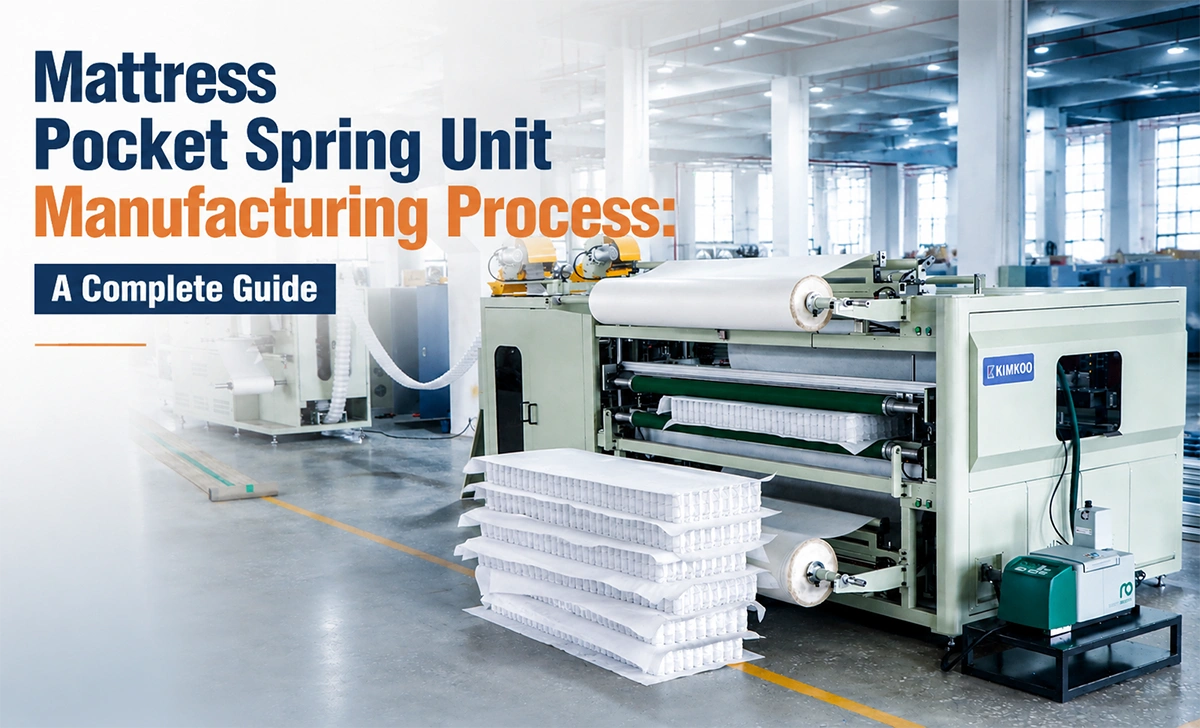
Pocket spring units are one of the most important components in modern premium mattresses. Unlike traditional interconnected spring systems, pocket springs are individually wrapped and work independently, allowing manufacturers to create mattresses with better support, improved motion isolation, and customized comfort.
For mattress manufacturers, the quality of the pocket spring unit directly affects the overall performance of the finished mattress. Factors such as steel wire quality, spring design, manufacturing accuracy, and assembly technology determine the firmness, durability, and long-term support of the mattress.
The pocket spring unit manufacturing process involves several important stages, including steel wire preparation, spring coiling, individual pocketing, spring row assembly, and final quality inspection. Each stage requires precise control and reliable manufacturing technology to ensure that every spring unit meets the required performance standards.
With the development of automated mattress production technology, modern factories increasingly use advanced equipment such as pocket spring machines to improve production efficiency, reduce material waste, and maintain consistent product quality. Understanding how pocket spring units are manufactured helps mattress producers select the right production methods and improve their manufacturing capabilities.
What Is a Pocket Spring Unit?
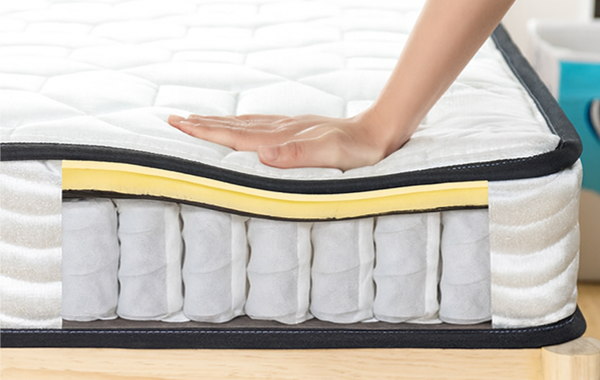
A pocket spring unit is a mattress support core made from thousands of individually wrapped coil springs connected together to form a complete spring structure.
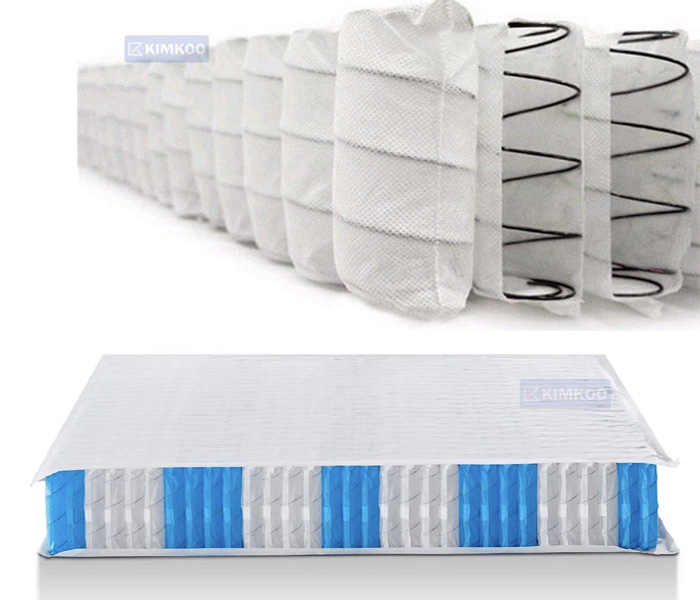
Each spring is compressed inside its own fabric pocket, allowing it to move independently from neighboring springs. This independent movement is the main reason pocket spring mattresses provide better body support and reduced motion transfer compared with traditional spring systems.
A high-quality pocket spring unit typically consists of:
- Individual coil springs
- Non-woven fabric pockets
- Ultrasonic welded seams
- Connected spring rows
- Zoned support structures (optional)
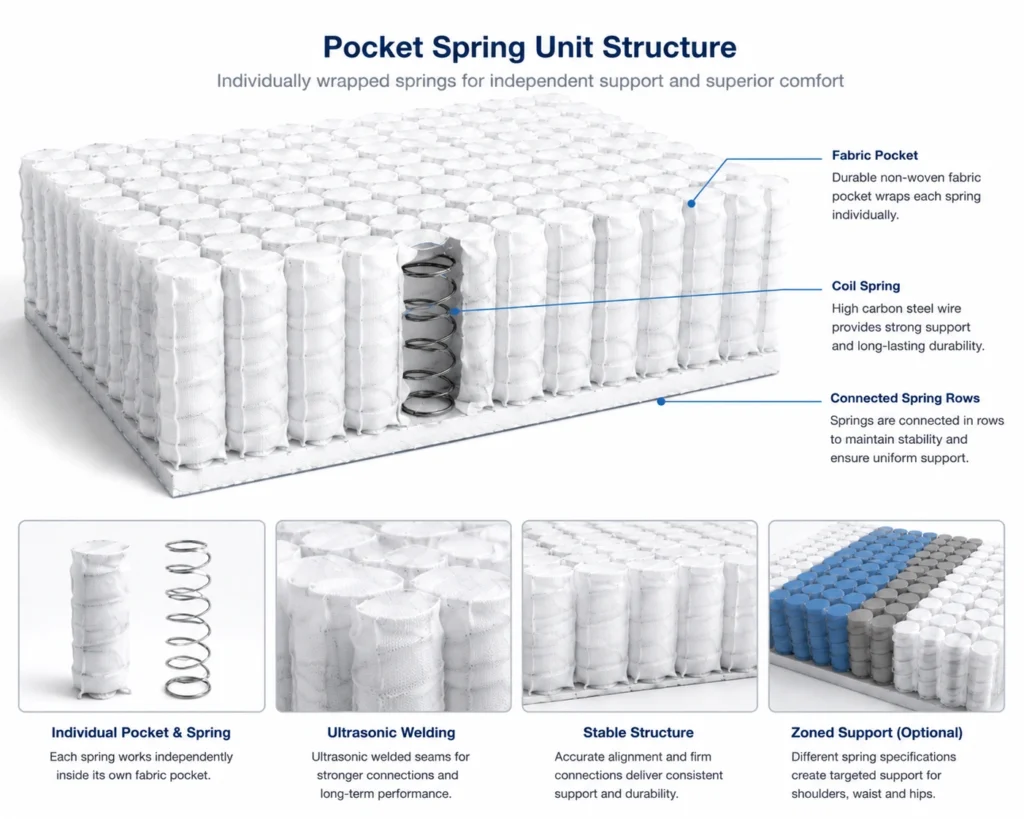
During mattress manufacturing, the pocket spring unit acts as the foundation layer that supports the sleeper’s body weight. The design and manufacturing quality of the spring unit directly influence:
Independent Support
Each spring responds separately according to applied pressure, allowing the mattress to better adapt to different body shapes and sleeping positions.
Better Motion Isolation
Because each spring works independently, movement on one side of the mattress has less impact on the other side.
Improved Comfort
Different spring configurations allow manufacturers to create mattresses with specific comfort levels, from soft to firm support.
Zoned Support Possibility
By combining springs with different wire diameters, heights, or coil structures, manufacturers can produce zoned mattress cores with different support areas for shoulders, waist, and hips.
For this reason, the manufacturing accuracy of the pocket spring unit is one of the most important factors determining the quality of a premium mattress.
How Are Pocket Springs Made?
Many mattress manufacturers ask: how pocket springs are made?
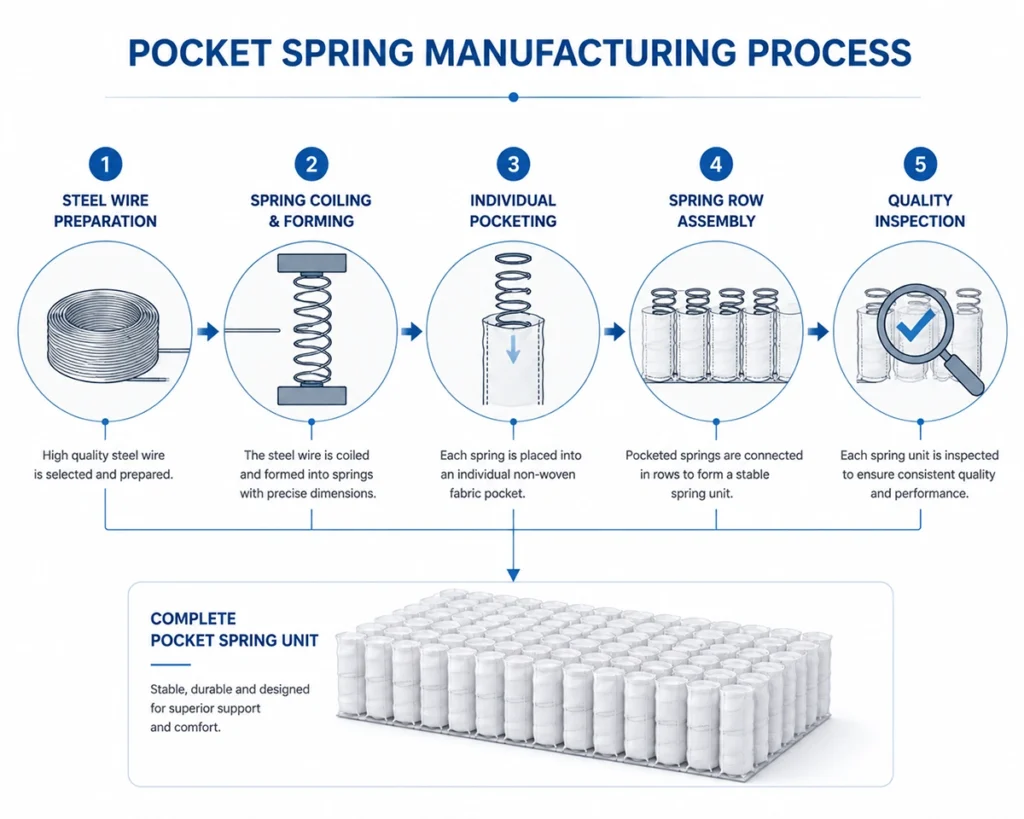
Although the production process may vary depending on the design requirements, modern pocket spring manufacturing usually includes several essential steps:
- Steel wire preparation
- Spring coiling and forming
- Individual pocketing
- Spring row assembly
- Quality inspection
Each step plays an important role in creating a stable and durable pocket spring unit.
Step 1: Steel Wire Preparation for Pocket Spring Production
The first stage of the pocket spring manufacturing process is selecting and preparing the correct steel wire.
Pocket springs are usually manufactured using high-carbon steel wire because it provides the necessary elasticity, strength, and fatigue resistance required for long-term mattress use.
Different mattress designs require different wire specifications. Important factors include:
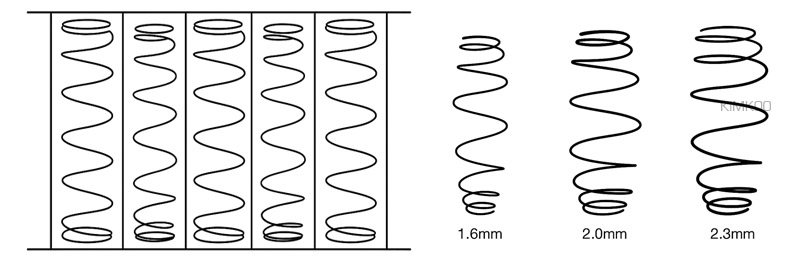
Wire Diameter
Wire diameter directly affects spring firmness and support performance.
- Thicker wire creates firmer support.
- Thinner wire provides softer comfort.
Mattress manufacturers often select different wire diameters according to:
- Mattress type
- Target market
- Comfort requirements
- Weight capacity
Steel Quality
High-quality steel ensures:
- Stable spring performance
- Better durability
- Consistent compression response
Spring Design Requirements
Before production begins, manufacturers must determine:
- Spring height
- Coil diameter
- Number of turns
- Spring shape
- Compression characteristics
These parameters influence the final mattress feeling and support level.
Therefore, precise control of raw materials is the foundation of producing high-quality pocket spring units.
Step 2: Pocket Spring Coiling Process
After steel wire preparation, the wire enters the spring forming stage.
This is one of the most important steps in the entire pocket spring unit manufacturing process, because the accuracy of spring forming directly affects the performance consistency of the final mattress.
During production, the steel wire goes through several automated procedures:
- Wire feeding
- Wire straightening
- Spring forming
- Cutting
- Heat treatment
- Cooling and shaping
Modern mattress manufacturers use a professional pocket spring coiling machine to complete these processes automatically.
Advanced CNC-controlled equipment can precisely control spring dimensions and production parameters, ensuring stable spring quality during high-speed manufacturing.
A modern automatic spring production system can integrate:
Automatic Wire Feeding
The wire feeding system delivers steel wire smoothly and continuously, reducing manual adjustment requirements.
Precision Spring Forming
Servo-controlled forming systems ensure that each spring maintains consistent:
- Height
- Diameter
- Coil shape
Heat Treatment and Cooling
Heat treatment improves spring stability and helps maintain the required elasticity after compression.
Automatic Detection and Counting
Intelligent production systems can monitor production conditions and identify problems such as:
- Missing springs
- Incorrect spring positioning
- Production abnormalities
This helps manufacturers reduce defective products and improve production efficiency.
For large-scale mattress factories, automation in the spring coiling stage is essential for achieving consistent quality and stable output.
Mattress Pocket Spring Production Line
A complete mattress pocket spring production line integrates multiple manufacturing processes into one continuous workflow, from steel wire forming to finished pocket spring unit assembly.
In a modern mattress factory, the production process usually includes:
- Steel wire feeding and preparation
- Automatic spring coiling and heat treatment
- Individual spring pocketing with fabric
- Spring row arrangement and bonding
- Final pocket spring unit forming
By combining advanced automation technology, manufacturers can achieve consistent spring quality, higher production efficiency, and better control over mattress comfort performance.
With extensive experience in mattress machinery manufacturing, KIMKOO Mattress Machinery provides complete pocket spring production solutions designed for modern mattress factories. Its automated production systems integrate advanced technologies for spring forming, pocketing, and unit assembly, helping manufacturers achieve stable quality, efficient production, and flexible mattress design capabilities.
A complete production line also allows mattress manufacturers to customize spring specifications, including wire diameter, spring height, coil design, and zoning structure. This flexibility enables factories to produce different types of premium mattresses according to market requirements.
Below are examples of automated pocket spring production lines, showing the complete manufacturing workflow from individual springs to finished mattress support cores.